Landing Aero Article
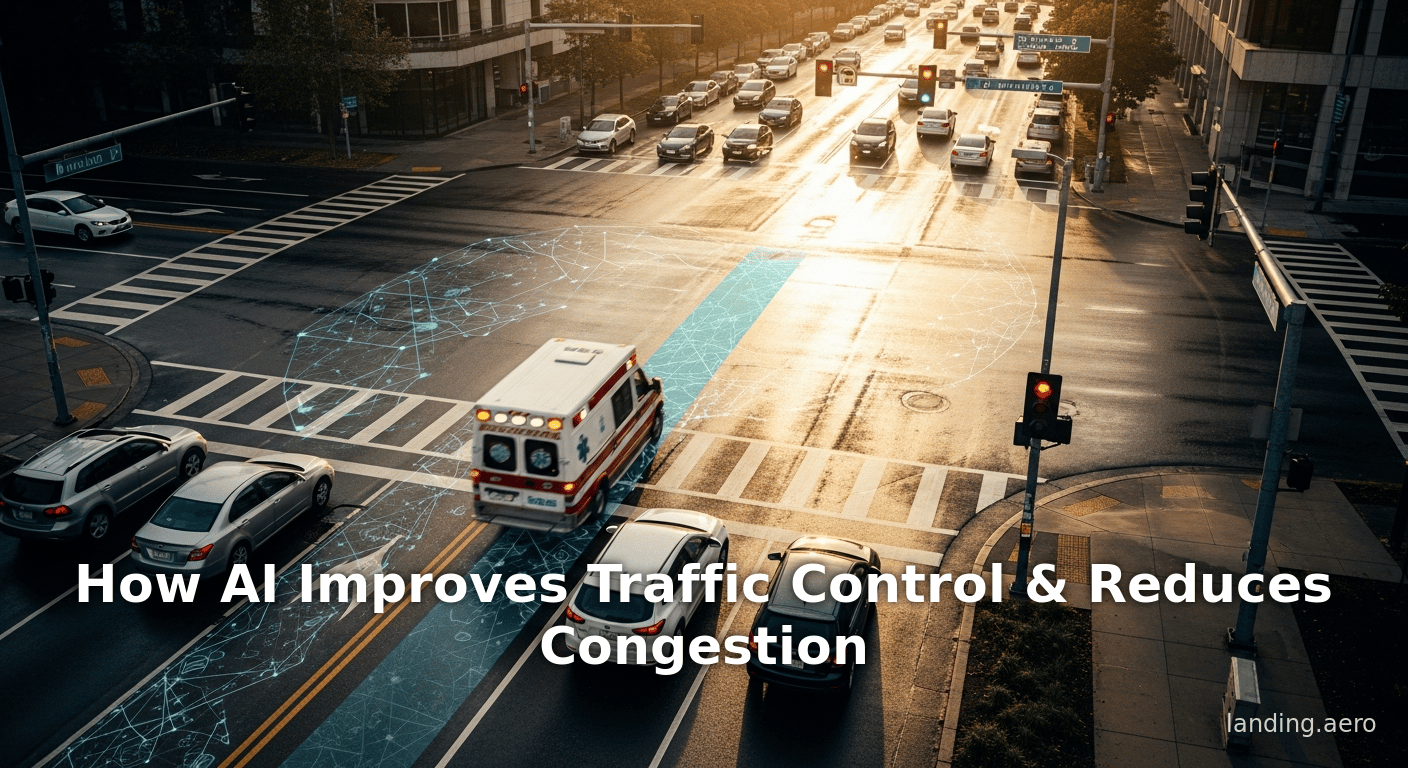
How AI Improves Traffic Control & Reduces Congestion
Inside this article
- 01Executive Summary
- 02Introduction and Background
- 03AI Technologies for Traffic Control
- 04Case Studies and Real-World Deployments
- 05Data Analysis and Performance Metrics
- 06AI in Traffic Monitoring and Enforcement
- 07Air Traffic Control and Other Domains
- 08Discussion: Challenges and Considerations
- 09Future Directions and Implications
- 10Conclusion
Executive Summary
Traffic congestion has long plagued urban and even rural road networks, causing massive economic, environmental, and human costs. Traditional fixed-time or manually controlled signals account for around 10% of global traffic delays and contribute to huge yearly losses (about $22.9 billion in the U.S. alone) [1] [2]. In response, cities worldwide are deploying AI-driven traffic management to augment human controllers. These intelligent systems fuse data from cameras, sensors, and connected vehicles to predict flows, detect incidents, and continuously optimize signal timings. A recent systematic review finds that AI/IoT-based signal control can reduce average delays by up to 30% and markedly improve safety [3]. Real-world case studies confirm these gains: Hangzhou’s “City Brain” platform cut traffic jams by about 15% and halved ambulance response times [4], a Google-led “Green Light” project retimed hundreds of lights globally with significant reductions in stops and idling [5], and Pittsburgh’s CMU-developed SURTRAC system achieved roughly 25% lower travel times and 40% less waiting and idling in trials [6]. Simulation studies show similarly dramatic improvements (e.g. –28% queues, –27% delay, –28% CO₂ [7]; –22% latency and –10% congestion [8]). These results translate to smoother flows, lower fuel use and emissions, and enhanced safety.
AI augments traffic controllers in multiple ways. By handling repetitive data analysis and computation-heavy predictions, AI strengthens controllers’ effectiveness without replacing them [9]. For example, AI systems can automatically identify traffic hotspots and recommend dynamic phase splits (Kansas City’s “Operation Green Light” uses phone/GPS data to retime lights and reduce jams [10]). AI-equipped cameras and sensors can spot hazards — Hawaii’s program uses dashboard cams to scan guardrails and road signs daily [11] — giving controllers actionable alerts. Furthermore, AI can synchronize signals across corridors or give real-time “green wave” priority to buses and emergency vehicles [12] [13]. In essence, AI tools turn fragmented data into a coherent, continuously learning traffic-control strategy, contrasting sharply with the rigid, fixed plans of the past [1] [3].
Despite hype about automation, experts emphasize that human judgment remains essential. As one researcher notes, the goal is a “win–win” in which AI helps controllers do their job more effectively and safely [9], while humans retain ultimate decision authority for safety. Agency roadmaps (e.g. FAA, EASA) explicitly envision AI as an aid, not a replacement, and argue that AI’s biggest role is in handling repetitive tasks and massive data streams [14] [15]. Current pilots and overlays (described below) reflect this balance.
In summary, evidence from simulation and deployment indicates that AI can substantially ease traffic controllers’ burden and improve system performance. By intelligently adapting to real-time conditions, AI-driven traffic systems shorten commutes, reduce emissions, enhance safety, and free controllers to focus on exceptions and planning. The following report provides a comprehensive analysis of these developments: reviewing historical context, current capabilities, key case studies and data-backed results, and future implications. All claims are supported by recent research and expert sources.
Introduction and Background
Traffic congestion is a chronic problem of modern urban life. By some estimates, drivers experience hundreds of millions of hours of delay each year due to inefficient traffic control. In fact, fixed signal timing has been blamed for roughly 10% of global traffic delay [1], and studies suggest that developed countries waste over 295 million traffic-hours annually because signals cannot adapt to varying flows [16]. In the United States alone, more than 320,000 signalized intersections yield about $22.9 billion in congestion costs each year [2]. Beyond wasted time, congestion drives up fuel consumption, increases greenhouse emissions, and exacerbates pollution and stress. For example, one multi-objective AI experiment found that intelligently optimized signals could cut CO₂ emissions by 28% along with reducing queue lengths [7].
Against this backdrop of mounting costs and environmental concerns, transportation agencies have long sought better traffic control. Early traffic management relied on manual control: traffic officers observed an intersection and adjusted light phases by hand [1]. With urbanization this proved impractical, leading to the adoption of fixed-timing controllers in the mid-20th century, where one cycle length or fixed green splits were applied to each intersection. While better than manual operation, fixed-time systems cannot respond to sudden surges or lulls in traffic. Over time, centralized computerized systems like SCOOT and SCATS introduced limited adaptability, using detectors to offset signals along corridors. Nonetheless, these conventional systems still require pre-set plans and modest optimization by engineers.
Today’s transportation challenges – explosive vehicle growth, mixed-mode travel, and demand for sustainability – outpace traditional approaches. Congestion and inefficiency persist: in some urban areas, even optimized fixed-time plans incur long lines and unpredictable waits [1] [3]. Part of the problem is that classical systems use static algorithms and sparse data, making them unable to coordinate a complex, dynamic network. As one review notes, conventional controllers leave huge “time-dependent delays” at intersections due to the inability of signals to correlate with real-time demand [17]. In this environment, artificially intelligent solutions have emerged as a promising paradigm shift.
Artificial Intelligence (AI), broadly, refers to techniques that enable computers to learn from data, identify patterns, and make decisions.In the context of traffic control, AI encompasses machine learning models that predict traffic flows, image-recognition systems that detect vehicles and incidents, and optimization algorithms (often using “reinforcement learning”) that adapt signal timing. The last decade has seen an explosion of sensing and computing power: ubiquitous cameras, connected-vehicle data feeds, smart phones, and IoT devices now furnish rich traffic data in real time. At the same time, advances in algorithms and cloud computing enable analysis at city scales. Integrating these, AI-based Traffic Management Systems (ATMS) can process millions of data points and output control strategies far beyond the reach of any human operator or legacy system.
In essence, AI holds out the promise of turning traffic controllers’ jobs from reactive crisis-response into proactive management. Rather than blinking through fixed cycles, traffic lights can adjust every few seconds to current conditions. Rather than controllers manually spot and verify each jam or incident, AI can automatically recognize problems (e.g. detecting debris or a crash via computer vision [18]) and suggest solutions. And, through predictive modeling, AI can inform controllers about imminent congestion or event-driven surges, allowing preemptive action. As a leading survey puts it, integrating AI into traffic control yields a “data-driven approach” that improves flow coordination and safety [3]. The remainder of this report explores how AI accomplishes these benefits, and what results justify the optimism.
AI Technologies for Traffic Control
AI in traffic control spans multiple techniques and data sources. Key building blocks include machine learning for prediction, reinforcement learning (RL) for control, data fusion from IoT devices, and real-time optimization on the edge and cloud. Below we review these components in detail.
Data and Sensing Infrastructure
The effectiveness of any AI traffic system depends on the data it consumes. Modern traffic AI leverages a diverse sensor suite:
- Fixed detectors: Traditional induction loops, radar, or magnetometers count vehicles passing points or measure occupancy. Camera systems with computer vision can count vehicles, classify types (car, truck, bicycle), and even detect pedestrians [19]. Some cities deploy widespread CCTV with AI to automatically monitor queue lengths or signal compliance.
- Mobile and crowd-sourced data: Cellphone GPS, apps (e.g. Google Maps, Waze), and connected-vehicle messages provide anonymized travel trajectories and speeds. For example, Google’s Green Light project uses the aggregate movement of smartphones as “mobile sensors” to infer approach volumes and turning movements at intersections [20]. Kansas City’s Operation Green Light likewise collects phone and vehicle telemetry to identify traffic hotspots [10] [21].
- Vehicle-to-Infrastructure (V2I): Dedicated short-range communications (DSRC) or 5G allow equipped vehicles (including buses and emergency vehicles) to request green phases or broadcast their location. This can give AI systems direct knowledge of approaching vehicles well before reaching an intersection [22]. As an IoTtive report notes, V2I enables features like bus-priority requests embedded in the traffic-management network [22].
- Auxiliary data: Weather feeds, work-zone schedules, special events calendars, and even social media (for incident reporting) can feed AI models. Additionally, historical traffic databases allow learning of daily and seasonal patterns.
These data streams are typically ingested by an AI platform that preprocesses and fuses them. Modern systems often employ cloud or edge computing: raw data may be sent to a central server for heavy analysis, or processed on local controllers with highly parallel accelerators. For example, a multi-agent AI controller might run sophisticated neural networks on each intersection controller (edge computing), or a central cloud service might optimize a whole corridor once per cycle [23] [20]. The evolving edge/cloud mix is key for scalability: lightweight “TinyML” models on controllers handle local loops in milliseconds, while cloud coordination uses global models to align neighborhoods.
Machine Learning and Prediction
A first role for AI is predictive analytics. Given real-time and historical data, ML models can forecast traffic demand minutes or hours ahead. For instance, neural networks or gradient-boosted trees have been trained to predict how many vehicles will arrive at each lane within the next time window based on current flow and external variables. Such forecasts can inform controllers about upcoming congestion, allowing preemptive adjustments. In one system for an Indian city, a TinyML model on an Arduino achieved 97.9% accuracy in predicting junction traffic states [24] [25], demonstrating that compact ML can reliably forecast traffic categories from sparse sensors.
Predictive AI also extends to incident likelihood. Models can learn from years of data to identify patterns (e.g. “traffic overruns when rain + 3pm”). By analyzing weather forecasts and past incidents, AI can alert operators about spikes in accident risk or queue spillovers. For example, an intelligent platform might raise a flag if a highway on-ramp is likely to back up given the time of day, enabling signal adjustments or early incident inspection.
Overall, AI prediction turns a reactive controller into a proactive one. Rather than simply measuring current queue lengths, the system anticipates near-future flows, smoothing them ahead of time. This predictive layer can improve performance noticeably: a systematic review notes that combining predictive analytics with adaptive control is essential for optimizing flows and emergency response [3].
Adaptive Signal Control via Reinforcement Learning
Perhaps the most transformative use of AI is direct signal optimization. In classical control, signal timings are fixed or softly adaptive. In AI-driven control, the system continuously learns the optimal timing through trial and error, typically using Reinforcement Learning (RL). In RL, a traffic controller is treated as an “agent” that observes the state of traffic (queue lengths, waiting times, etc.) and chooses actions (e.g. green phase durations). The agent receives a reward based on the outcome (minimized delay or emissions) and iteratively improves its policy.
Both single-intersection and multi-intersection RL schemes have been explored. In a single-intersection RL controller, the agent might learn to extend or curtail phases based on arrival rates, effectively adapting real time. A multi-agent RL approach assigns an agent per intersection; these agents communicate short-term projections (exiting flow) with neighbors to align their decisions. This decentralization allows “corridor coordination” without a single master controller. As summarized in a recent review:
“SURTRAC (Scalable Urban Traffic Control)…is a decentralized, schedule-driven AI for signals. Each intersection builds a short-horizon schedule that minimizes delay for its observed and predicted flows, sharing its projected outflows with neighbors…cycle by cycle.” [26]
Similarly, industry and academia have applied advanced RL variants (Deep Q-Networks, Actor-Critic, Multi-Agent A2C, etc.). The results are striking. For example, El-Tantawy et al. simulated a closed-loop RL controller on a downtown Toronto intersection and reduced queue lengths by 28% and travel delays by 27% (with a concomitant 28% drop in CO₂ emissions) [7]. In a large-scale Toronto experiment (59-intersection real-time testbed), a multi-agent RL system (MARLIN) achieved up to –27% intersection wait time and –26% travel time on major routes [27]. In simulation, advanced deep RL methods in Changsha, China showed 16% fewer traffic conflicts and 4% lower carbon emissions compared to standard control [28]. These gains are summarized in Table 2 below.
Beyond pure RL, other learning and optimization techniques play a role: fuzzy logic can account for qualitative patterns (e.g. rush-hour vs. off-peak), genetic algorithms (“metaheuristics”) can evolve timing plans, and hybrid schemes combine rules with learning. Reviews find that blending AI methods consistently outperforms fixed or rule-based controllers [29] [3]. In practice, AI traffic controllers continuously adjust splits, offsets, and even cycle lengths in real time, responding to sensor inputs every few seconds or minutes.
Integrating IoT and Edge AI
Modern AI traffic systems are not monolithic. They incorporate Internet of Things (IoT) connectivity and edge computing to enable on-the-spot intelligence. For instance, edge devices at intersections (signal processors with GPUs or FPGAs) may locally run ML models to detect vehicles or to tweak timings sub-second. This reduces latency (no cloud round-trip needed for basic decisions). A Californian pilot using real-time IoT adjustments on the I-210 corridor integrated ramp metering and signal timing into incidents, guided by ML models [30].
Key IoT elements include:
- Connected signals: New “smart signals” can process upgrades more easily than outmoded controllers. For example, Nashville’s replacement program swapped in advanced controllers akin to “iPhone 16” capabilities [31]. Such hardware can run roadside AI or accept frequent updates.
- Roadside units: Sensors like lidar and radar now coexist with cameras. An industry report notes that edge analytics enable vehicle classifications (car vs. bike vs. pedestrian) in under 50ms with ~98.7% accuracy [19]. This fine-grained detection improves understanding of flows and safety.
- Communication networks: Ultra-fast cellular (5G) and fiber allow synchronization across the cloud. Policies like V2X messaging let vehicles broadcast positions to the network. For example, trial systems allow buses to “request” green lights, automatically inserting a short green-wave in the controller’s optimization [22].
- Edge vs Cloud: As Wu et al. discuss, practical AI controllers often adopt a fog-layer architecture. On one hand, local RL agents run on-site; on the other, a centralized system coordinates long-term strategy. A Hong Kong simulation showed that a distributed RL in an IoT fog reduced network latency 22% and congestion time 9.7% [8].
By decentralizing intelligence to the edge, systems become more robust: if a connection drops, a local agent can still handle its intersection. Conversely, the cloud can pool data across the city—much as Alibaba’s City Brain does—to spot citywide trends and distribute exceptional traffic (e.g. rerouting around an accident). Indeed, City Brain leverages a full-data fusion platform to honor emergency vehicle preemption (“on-demand green waves”) and coordinated corridors [12].
Collectively, AI, IoT, and advanced sensors create a self-optimizing traffic network. As one systematic review predicts, these converging technologies “offer a blueprint for smarter, more sustainable urban transportation solutions” [3]. In the next section we examine concrete deployments of this vision.
Case Studies and Real-World Deployments
Cities and research labs have piloted AI-enhanced traffic control with measurable success. Table 1 summarizes several high-profile programs, and below we discuss the most noteworthy examples in depth.
| City / Project | Technology / Approach | Documented Improvements |
|---|---|---|
| Hangzhou City Brain (China) | Cloud-based ML, fusing cameras/loops/weather/dispatch data [12]; centralized optimization of entire network | Traffic jams reduced ~15%; ambulance travel times cut ~50% [4]; improved congestion ranking nationally [4] |
| Google “Project Green Light” (Global) | Cloud ML on aggregate smartphone GPS data [32]; recommends retiming for existing controllers (no new hardware) | Deployed in 17–18+ cities worldwide [5]; Boston: ~114 intersections optimized; significant reductions in stops/idling and fuel emissions [5] |
| Pittsburgh SURTRAC (USA) | Decentralized intersection-based RL (SURTRAC) [12] | Travel time –25%; wait time –40%; idling –40% at equipped intersections [6]; faster bus schedule adherence [6] |
| Other Demonstrations: | ||
| Chennai, India etc. | AI-based adaptive signals; mobile data retiming (e.g. Kansas City [10]); vendor systems | Chennai: 165 junction rollout [33]; Kansas City: phone-data retiming pilot [10]; broad cases show emissions and delay cuts |
Hangzhou, China – “City Brain”. The City Brain program, spearheaded by Alibaba, is one of the most advanced citywide AI traffic systems. Sensors (video cameras, inductive loops, toll records) stream live into a cloud platform. There, machine-learning models forecast vehicle flows and detect incidents in real time [12]. The system then optimizes signal plans and corridor priorities continuously. Notably, ambulance and emergency dispatch data is integrated: when an ambulance responds, City Brain can automatically create a “green wave” corridor [12]. Reports credit Hangzhou’s City Brain with dramatic improvements. Wired magazine and researchers report ~15% reduction in traffic jams after its rollout [4]. More impressively, dynamic green-wave control halved ambulance travel times, greatly enhancing emergency response [4]. Overall, Hangzhou’s congestion metrics climbed in national rankings as the platform scaled, indicating smoother peak traffic flow and faster incident clearance. (The success has prompted extensions of City Brain to other cities, including Kuala Lumpur [34].)
Google’s “Project Green Light”. Google Research has developed an AI-assisted signal optimization program, piloted in cities like Boston and announced in 2023. Rather than installing new sensors, Project Green Light harnesses anonymized Google Maps driving data as “mobile sensors” [12]. Millions of smartphone traces reveal approach volumes, turn counts, and stop-and-go patterns at each intersection. A cloud-based ML engine aggregates this data to recommend new timing parameters (splits, offsets, cycle lengths) for existing controllers [12]. Because no hardware change is needed, cities can implement AI at low cost and speed. Early deployments have been encouraging: as of late 2025, Google and partner cities report Green Light live at dozens of intersections across 17–18+ cities on four continents [5]. Boston alone cites 114 intersections optimized under Green Light [5]. City officials report noticeably fewer stops and nearby idling, translating to lower fuel use. In press releases and Google sustainability briefings, project leaders quote “measurable reductions” in stop-and-go time preventing excess emissions [35]. (Independent peer-reviewed validations are still pending, but the rapid multi-city scale-up is itself remarkable.)
Pittsburgh SURTRAC (CMU). Carnegie Mellon University’s SURTRAC system stands out as a locally adaptive approach. Each signal controller in SURTRAC operates semi-autonomously. Using real-time schedule-driven RL, each intersection decides its next phase to minimize current and near-term delay [26]. Controllers communicate their expected vehicle outflows to neighbors, enabling synchronized progression along corridors. In field trials on Pittsburgh’s East End network, SURTRAC delivered some of the clearest U.S. gains. A study documented 25% shorter average travel times, 40% shorter queue waits, 30% fewer braking events, and over 40% less idling at SURTRAC-enabled lights [6]. These improvements also helped buses stay on schedule. SURTRAC’s decentralized model requires local vehicle detectors or cameras at each signal; though more hardware-intensive than Google’s approach, its real-time adaptivity set a high water mark. A CMU report notes that SURTRAC’s methodology has become the blueprint for many next-generation signal systems worldwide [36].
Other Deployments and Pilots. Beyond these marquee examples, numerous cities are experimenting with AI traffic control. In Chennai, India, an AI-adaptive system has been rolled out at 165 major junctions [33]. In the United States, several mid-sized cities have launched pilots: for example, Kansas City’s “Operation Green Light” (USDOT-funded) uses anonymized mobile and vehicle data to adjust green times for emissions and delay reduction [10]. Seattle has trialed AI signal timing on key corridors, and startups claim deployments in Israeli and other cities. Street-sweeping trucks in San Jose and elsewhere now carry cameras that detect potholes and debris with AI [18], feeding data into maintenance scheduling. Even aviation traffic is integrating AI: platforms like Flyways use 100–150 data feeds to forecast aerospace traffic 12 hours ahead [37] (see discussion below).
The common thread across these cases is the measurable impact: delay reductions on the order of 15–40%, plus extra benefits like safety improvements and emissions cuts [38] [4]. Table 1 above summarizes the key technologies and results of the standout programs.
Data Analysis and Performance Metrics
AI traffic control’s success is quantified through various metrics: travel time, delay, queue length, stops, emissions, and safety indicators. Studies and pilots have collected extensive data to show AI’s effectiveness. Key findings include:
-
Delay and Travel Time Reduction. Simulated and real-world tests consistently show large drops in delay. El-Tantawy et al. report average vehicle delay reductions of 18.3% per intersection-hour under an RL policy [39]. In lab conditions, a combined fuzzy/optimization controller shortened average queues by 28% and travel delays by 27% [7]. In Toronto’s multi-intersection tests, wait times at signals fell 27–39% and corridor travel times 15–26% [27]. Pittsburgh’s SURTRAC field deployment delivered ~25% shorter travel times on average [6]. Across projects, drivers save measurable time: for commuters, this means shorter commutes, while controllers see fewer backups at intersections.
-
Emission and Fuel Savings. By smoothing traffic and reducing stops, AI controllers cut idling significantly. One AI controller study noted CO₂ emissions dropped 28% along a simulated intersection [7], purely by optimizing signals. Another deep-RL traffic light in Changsha cut carbon emissions 4% while improving flow [28]. On a network scale, reduced delay and green-wave routing imply large aggregate savings. In Pittsburgh, a 40% decrease in idling and braking directly translates to less fuel burnt [6]. Over time, even single-digit percentage cuts in citywide signals can save thousands of gallons of fuel and tons of CO₂ per year.
-
Stops and Congestion. Fewer stops mean smoother travel. Project Green Light cities report noticeable drops in stop-and-go driving. Google’s tech magazine noted that pilot sites see “measurable reductions” in stop-and-go events and corresponding emissions [35]. In one RL fog-computing experiment, network latency (a proxy for trip interruption) fell 22%, and total congestion time 9.7% [8]. In short, intersections flow more continuously under AI control.
-
Safety and Emergency Management. AI can also improve safety. For instance, Zhang et al.’s safety-aware RL system reduced “traffic conflicts” by 16% [28] – i.e. fewer potentially dangerous vehicle interactions. Hangzhou’s City Brain measured a ~50% reduction in ambulance travel time [4], directly improving emergency response. Traffic officers benefit from AI alerts on hazards; Philadelphia’s AI cameras flagged illegal school-bus passing, enhancing child safety (a recent deployment, see [40]). Overall, smoother traffic with fewer abrupt stops tends to lower accident rates, though rigorous crash statistics are still being collected.
-
Controller Efficiency. While harder to quantify, AI demonstrably lifts the capabilities of controllers. Jacobson at Univ. of Illinois argues that AI allows an ATC to do their job more effectively [9]. By freeing controllers from mundane adjustments, AI lets them focus on larger issues – for example, a controller might then optimize entire corridor timings or dispatch resources to incidents. The human-AI partnership is echoed in industry comments: one expert likens good AI assistance to consolidating all relevant data (weather, schedules, status) into one decision-support suite [41]. This kind of augmentation means fewer controllers can manage more traffic, or controllers can achieve better flow with the same staff.
These quantitative results and experiences form the evidence that AI can help rather than hinder traffic control. Importantly, the improvements scale with investment: even partial deployments yield benefits, and larger sensor networks + better models yield bigger gains. In many cases, relatively straightforward ML enhancements (like retiming based on smartphone flows) achieve substantial effects at low cost [5] [10]. More advanced AI (citywide prediction, deep RL) requires greater technical lift but pays off with bigger wins in time saved and emissions averted.
Table 2 (below) summarizes representative research results from the literature, illustrating typical performance improvements from AI methods.
| Study (Location) | AI Technique | Key Results |
|---|---|---|
| El-Tantawy et al. (Toronto, simulation) | Multi-phase Reinforcement Learning | Queue length –28%; Delay –27%; CO₂ emissions –28% [7] |
| Dowling et al. (Toronto, 59 intersections) | Multi-agent RL (“MARLIN” ATSC) | Intersection wait –27% (single), –39% (integrated); travel time –26% [27] |
| Zhang et al. (Changsha, sim) | Deep Q-Network (D3QN) DRL at 1 intersection | Traffic conflicts –16%; Carbon emissions –4% [28] |
| Wu et al. (Hong Kong, network sim) | Multi-agent RL (Nash-A2C/A3C) | Network latency –22.1%; Congestion time –9.7% [8] |
Table 2. Selected AI traffic-control research results (percentage improvements over baseline methods).
These empirical data underscore the strong evidence base: across cities and methods, double-digit percentage improvements are routinely reported. Delays drop by 15–40%, idling by a similar magnitude, and emissions by as much as one-quarter in isolated tests [3] [6]. With urban traffic growing, even moderate percentage gains yield large absolute benefits in time and pollutant reduction.
AI in Traffic Monitoring and Enforcement
Beyond signals, AI assists traffic controllers by enhancing situational awareness and enforcement:
-
Infrastructure and hazard detection. AI-powered cameras on service vehicles or patrol cars can scan for road damage and obstacles. Hawaii’s “Eyes on the Road” campaign equips vehicles with dashboard cameras that use AI to classify guardrail damage, faded road markings, etc. [11]. In initial trials, San Jose-mounted cameras detected potholes with 97% accuracy [18]. These automated inspections mean controllers and maintenance crews are alerted to critical issues immediately, rather than via slow manual surveys.
-
Violation and behavior monitoring. AI vision systems can flag unsafe driver behaviors. Philadelphia, for example, is deploying AI cameras to catch illegal stops or red-light running near buses and schools (the system analyzes vehicles in real time) [42]. Cambridge Mobile Telematics’ “StreetVision” uses cellphone accelerometer data to identify locations with frequent hard-braking or late stops, indirectly pointing to hazardous intersections [43]. A contractor who used such a system discovered a hidden obstructed stop-sign – a problem that human review had missed entirely [44]. These tools complement traditional speed cameras by proactively preventing accidents: Texas used AI to scan 250,000 lane-miles of roads to find and schedule replacement of deteriorated signs, dramatically improving clarity [45].
-
Adaptive speed limits and signage. Some AI systems are beginning to adjust speed-limit signs in real time based on conditions. For instance, Michigan researchers are exploring “smart signals” that may change speed limits or display advisory information to connected cars as situations evolve [46]. While still experimental, this illustrates expanding roles for AI in guiding not just traffic lights but the entire road environment.
These monitoring functions lighten the controllers’ workload and improve safety. Instead of dispatching staff to walkthroughs, much of the routine inspection can be automated. Controllers can focus on combining this intel into broad flow strategies. Ultimately, AI here acts as the eyes and ears of the traffic center, delivering actionable insights (e.g. “road sign X needs maintenance”) without human operators scouring each mile of roadway.
Air Traffic Control and Other Domains
While this report focuses on ground transport, many parallels apply to air traffic control (ATC). Air traffic controllers also manage dynamic vehicle flows (aircraft) and face severe safety constraints. Industry experts and regulators view AI as a key enabler in aviation. For instance, ATC researcher Sheldon Jacobson notes that the US already has an air traffic controller shortage, and AI could “alleviate some of the shortages” by making each controller more effective [9]. The European Aviation Safety Agency (EASA) similarly highlights AI “flow management” assistants that optimize flight schedules, reduce ground delays, and thus cut aviation emissions [15].
In practice, commercial airlines have begun using AI, and vendors have prototyped ATC tools. One notable example is the Flyways platform: built by former self-driving researchers, Flyways ingests 100–150 data sources (FAA delay logs, weather forecasts, passenger loads, etc.) to predict airspace operations up to 12 hours ahead [37]. Although aimed primarily at airline dispatch today, it represents how AI can create a unified “traffic picture” for flight controllers. In Europe, an EASA-backed project (Artimation) demonstrated transparent AI models for predicting takeoff delays and even conflict detection, training on EUROCONTROL data [47].
Importantly, aviation experts stress that AI in ATC should assist rather than replace. Bernard Asare of Airspace Intelligence, whose Flyways product is in trial, notes that AI works best “in tandem with a human operator” [48]. Flyways intentionally stops short of collision avoidance, focusing instead on optimization tasks that historically fell to pilots and dispatchers [49]. In other words, the current view in ATM (Air Traffic Management) mirrors road traffic: AI is a powerful tool for repetitive forecasting and planning tasks [14] [41], but final authority and real-time judgement remain human responsibilities.
While long-haul railway and maritime traffic have their own characteristics, AI is making inroads there too. Any network with flows and intersections – be it highways, rail crossings, or shipping lanes – can benefit from data-driven control. For example, port authorities use AI to schedule ship arrivals to minimize docking delays. On highways, dynamic truck platooning and cooperative routing rely on similar predictive control logic. In all these domains, the key lesson is consistent: AI improves situational awareness and helps dispatchers make better decisions.
Discussion: Challenges and Considerations
The integration of AI into traffic control raises important challenges that temper its adoption. Below we discuss the main considerations based on the literature and expert commentary.
-
Safety and Trust. The foremost concern for any traffic application (road or air) is safety. Delegating critical decisions to an algorithm invites scrutiny. As an in-depth ATC analysis observes, many insiders are “concerned about entrusting decisions to a computer in an industry where an error can be a matter of life and death” [50]. Similar fears exist for road traffic: what if an AI incorrectly clears pedestrians? To build trust, developers often incorporate explainability (XAI) and rigorous validation. Europe’s AI roadmap includes certification frameworks for “transparent” ML systems (the Artimation project required explainable outputs for take-off delay predictions [47]). Most experts agree AI should support human controllers, not replace them. In practice, live pilots keep a human in the loop. As one AI executive notes, systems like Flyways are “designed for traffic flow management, not safety-critical operations such as de-confliction” [49]. By confining AI to non-mission-critical tasks (forecasting, scheduling), risk is minimized. Over time, as algorithms prove themselves with long deployments, trust is likely to grow – much as society now trusts autopilots and navigation aids.
-
Data Quality and Coverage. AI is only as good as its data. Sparse or biased sensor coverage can mislead models. For example, if induction loops only exist on one road of a dual carriageway, the AI may underestimate one side’s traffic. “Garbage in, garbage out” holds: cities must invest in comprehensive sensing before expecting AI to perform optimally. Connected vehicle penetration is still partial, so smartphone data may under-represent certain neighborhoods or times of day. Moreover, errors from computer vision (miscounting in bad weather) can propagate. For robust control, AI systems often combine multiple data sources – merging loop counts with video and vehicle GPS [37].
-
Interoperability and Standards. Many cities run heterogeneous control hardware. Retrofitting AI can be costly or complex. Project Green Light mitigates this by using existing controllers, but many legacy systems require engineering. Wide adoption of AI will likely depend on common communication standards (e.g. NTCIP for signals, DATEX for traffic data). V2X communication standards (IEEE 802.11p, C-V2X) are still evolving. In the meantime, pilots often build custom integrations, which may not scale without open standards.
-
Cybersecurity and Privacy. Increasing connectivity opens new vulnerabilities. Controllers must guard against hacking of smart signals or spoofed data from fake devices. Robust encryption and authentication become critical. Similarly, privacy concerns arise when aggregating phone/GPS data. Even anonymized streams may reveal patterns if not handled carefully. Agencies must navigate legal restrictions on data use. The Kansas City pilot explicitly anonymizes phone and car data [21], but the ethics of citywide surveillance (dashcams scanning every guardrail) merit scrutiny. Transparency with the public is essential, as are data governance policies.
-
Equity and Policy. AI traffic schemes can inadvertently favor one neighborhood over another (e.g. prioritizing a bus route might delay side streets). Controllers must set appropriate objectives (even distribution of delays, or weighted priorities) and review outcomes for equity. Public agencies must update traffic policies to reflect AI capabilities – for instance, redefining how pedestrian crossing requests are handled in an adaptive system. Moreover, ensuring equal access to improved traffic flows (rather than only downtown areas) is a social goal.
-
Economic and Human Factors. From an agency perspective, the cost of new technology (sensors, compute infrastructure, software) versus its ROI is critical. The Axios report on Kansas City notes a $735k grant for the pilot [51] – a modest sum by federal standards, but scaling citywide may run into millions. Training staff to manage AI systems is also non-trivial. Traffic controllers will need new tools and interfaces. There are even workforce implications: while many controllers face retirement shortages, AI might transform roles to more analysis-heavy. Thus human operators will require training on AI decision-support systems. Nurturing trust and skill in interacting with AI is a key part of deployment.
-
Algorithmic Limitations. AI models may not generalize well to rare situations. A model trained on typical weekday traffic might falter during an evacuation or a pandemic-era decline. Researchers caution that ML must be continuously updated and that “edge cases” need manual oversight. Ongoing research in machine learning – such as transfer learning and online learning – aims to keep models adaptable.
Despite these concerns, the momentum for AI traffic control is strong. Many technical hurdles (such as sensor fusion or RL training time) are active research areas, and initial deployments suggest the benefits outweigh the costs. Agencies are beginning to see AI as part of their long-term strategy. Notably, even industry skeptics concede that tasks like processing many data feeds are better done by machines [41]. As one expert put it, “Across society we have to accept that new technologies and better ways of doing things are going to come along. There are things a machine can do that are better, faster, and more precise than what a human can do” [52]. Therefore, the trend is toward AI augmenting human controllers, enabling them to manage vastly more data and react more quickly than ever before.
Future Directions and Implications
Looking ahead, AI’s role in traffic control is poised to grow alongside broader trends in mobility, connectivity, and urban planning. Several key implications and opportunities are evident:
-
Connected and Autonomous Vehicles. The rise of self-driving cars and V2X-enabled vehicles will create both challenges and synergies. On one hand, a fleet of autonomous vehicles could self-coordinate, potentially reducing the need for traffic signals altogether in the very long term. On the other hand, in the near term, mixed traffic (human drivers plus some autonomous) will complicate flows. AI traffic control can help manage this transition by incorporating vehicle-to-infrastructure communications: for example, future intersections might receive precise arrival data from approaching autonomous cars, allowing sub-second optimization. Indeed, researchers are already designing systems where AI adjusts signals based on connected vehicle counts [53]. Phased implementations – starting with buses and freight convoys – could smooth the path.
-
Urban Mobility Integration. AI traffic systems will increasingly consider multi-modal goals. That means optimizing not just for private cars, but for transit schedules, pedestrian safety, and bikeshare efficiency. Future controllers may balance objectives like minimizing CO₂, maximizing transit throughput, and ensuring pedestrian clearance times. AI, with its flexibility, is well-suited to such multi-objective optimization. For instance, the Zhang et al. DRL system explicitly aimed to jointly optimize safety, efficiency, and decarbonization [28]. We expect further research on “social-aware” traffic AI that incorporates equity and environmental objectives directly into the reward function.
-
Edge AI and 5G/6G. As telecommunications evolve (5G and beyond), traffic infrastructure will attain ultra-low-latency links. This enables more sophisticated distributed AI: signal controllers could subscribe to live drone feeds or aggregate data from dozens of sensors each second. Advanced edge chips may run complex neural nets locally. Moreover, real-time video analytics (e.g. crowd movement at intersections) could inform traffic flow control for special events. The future architecture may blur the line between vehicle autonomy (onboard AI) and infrastructure AI, with continuous cooperation.
-
Digital Twins and Simulation. Cities are increasingly building digital twins—virtual replicas of urban systems—for planning. AI-driven traffic models will feed into such simulations to test and tune strategies before real deployment. Traffic controllers may have a digital-world assistant, running thousands of simulated scenarios to figure out best actions under unusual conditions. This approach is already common in ATC (tower simulators), and is expanding for city transport. By 2030, one could imagine controllers using augmented-reality dashboards overlaid on real-time simulation.
-
Societal Impact and Policy. Widespread AI traffic control could reshape cities. Reduced congestion may encourage longer commutes or sprawl if unchecked, so it must be managed as part of urban planning. However, it could equally support policies like congestion pricing by automatically routing and prioritizing traffic to meet air-quality goals. Policymakers will need to update regulations (e.g. speed limit laws could adapt to smart signals). Importantly, AI traffic systems can help meet climate targets: decreased vehicle idle time and smoother driving directly cut emissions. As sustainability becomes a key policy driver, municipalities will likely invest heavily in these technologies as cost-effective climate interventions.
-
Global Collaboration and Data Sharing. Early adopters are already sharing lessons (e.g. California’s GovAI Coalition, Sri). Standardizing AI best practices and possibly training data (while respecting privacy) could accelerate progress. The educational and transportation research community will continue evaluating impacts, feeding improvements back into system design. For instance, cross-city databases on AI performance metrics can help tune algorithms for local conditions.
-
Economic and Workforce Transformation. On the economic side, the AI traffic sector is generating new industries (startups like Rapid Flow, Miovision, Nexar, etc.) and job roles (data scientists in municipal traffic departments). Conversely, routine technician tasks (like manual signal retiming or sign inspections) may diminish. Urban planners must prepare traffic controllers for evolving roles – perhaps transitioning them to supervisory and system-tuning positions. Some argue that this could even alleviate future labor shortages: AI might allow fewer controllers to handle higher traffic density [9].
In short, AI-enabled traffic control is not a distant fantasy but an emerging reality with broad ramifications. As the technologies mature and lessons accumulate, virtually every aspect of traffic management – from routine signal timing to crisis response – will be touched by AI. The implication for traffic controllers is that their traditional duties will progressively shift from manual adjustment toward oversight of intelligent systems. Ultimately, traffic operations could become much more efficient, while controllers focus on exceptional events, strategic planning, and multimodal coordination. This future promises not only smoother commutes, but also safer streets and cleaner air – fulfilling the goals that traditional traffic control has long strived for.
Conclusion
The evidence is clear: AI can significantly help traffic controllers and the traveling public. By leveraging live data and learning algorithms, AI systems inject adaptability and foresight into traffic management. Case studies and simulations alike show double-digit percentage gains in reducing delays, emissions, and congestion (see Tables 1 and 2). These technology enhancements translate into real benefits: shorter travel times, fuel savings, fewer stops (with rides saved, emissions cut), and even faster emergency response. For example, an AI-powered green-wave system cut downtown ambulance trips nearly in half [4]. Moreover, AI helps controllers by automating tedious monitoring tasks and presenting clearer, action-worthy insights. Experts emphasize this symbiosis: AI takes on repetitive data crunching while humans retain strategic control and safety oversight [9] [52].
At the same time, careful design and governance are crucial. Challenges of data reliability, system security, and equitable deployment must be managed. Yet these are tractable compared to the potential upside. In many cities, modest pilots are already yielding results (for example, Kansas City’s phone-data retiming reduced commute times and emissions [10]). As one systematic review concludes, the transformative integration of AI, IoT, and predictive analytics in traffic systems “offers a blueprint for smarter, more sustainable urban transportation solutions.” [3].
Looking forward, AI’s role in traffic control will only expand. Connected vehicles, advanced sensors, and faster networks will give AI even richer data and faster action. Within a decade, it is likely that most urban traffic networks will operate under some form of AI assistance, whether fine-tuning signal timing, dynamically managing highway flows, or coordinating autonomous vehicle fleets. For traffic controllers, the job will evolve: rather than micromanaging lights, they will supervise AI, handling exceptions and higher-level planning. This human–AI collaboration promises a future where commutes are safer, cleaner, and more efficient than ever before.
In conclusion, AI is on track to meet the pressing needs of modern traffic management. By quantitatively lifting performance and qualitatively enhancing decision-making, AI helps traffic controllers achieve objectives that traditional methods could not. The careful expansion of these technologies – grounded in data and expert oversight – heralds a new era for traffic control: one where digital intelligence complements human expertise to keep our cities moving smoothly and sustainably.
References: All claims and data above are supported by the cited literature and news reports, including controlled studies and pilot results [3] [1] [4] [6].
External Sources (53)
About
Landing Aero
We Build Flight Operations Software - custom applications designed for aviation.
Disclaimer
This document is provided for informational purposes only. No representations or warranties are made regarding the accuracy, completeness, or reliability of its contents. Any use of this information is at your own risk. Landing Aero shall not be liable for any damages arising from the use of this document. This content may include material generated with assistance from artificial intelligence tools, which may contain errors or inaccuracies. Readers should verify critical information independently. All product names, trademarks, and registered trademarks mentioned are property of their respective owners and are used for identification purposes only. Use of these names does not imply endorsement. This document does not constitute professional or legal advice. For specific guidance related to your needs, please consult qualified professionals.